勇闯秋招手撕系列 II:双指针
约 1072 个字 137 行代码 1 张图片 预计阅读时间 5 分钟 总阅读量 次
移动零
验证回文串 (150)
判断子序列 (150)
盛最多水的容器
🌟 三数之和
🌟 最接近的三数之和
接雨水
283. 移动零
给定一个数组 nums,编写一个函数将所有 0 移动到数组的末尾,同时保持非零元素的相对顺序。
请注意 ,必须在不复制数组的情况下原地对数组进行操作。
示例 1:
输入: nums = [0,1,0,3,12] 输出: [1,3,12,0,0]
class Solution:
    def moveZeroes(self, nums: List[int]) -> None:
        """
        Do not return anything, modify nums in-place instead.
        """
        l = 0; r = 0
        n = len(nums)
        while r < n:
            if nums[r] != 0:
                nums[l], nums[r] = nums[r], nums[l]
                l += 1
            r += 1
125. 验证回文串
如果在将所有大写字符转换为小写字符、并移除所有非字母数字字符之后,短语正着读和反着读都一样。则可以认为该短语是一个 回文串 。
字母和数字都属于字母数字字符。
给你一个字符串 s,如果它是 回文串 ,返回 true ;否则,返回 false 。
输入: s = "A man, a plan, a canal: Panama" 输出:true 解释:"amanaplanacanalpanama" 是回文串。
class Solution:
    def isPalindrome(self, s: str) -> bool:
        n = len(s)
        s = s.lower()
        l = 0; r = n - 1
        while l <= r:
            while l < r and not s[l].isdigit() and not s[l].isalpha():
                l += 1
            while l < r and not s[r].isdigit() and not s[r].isalpha():
                r -= 1
            if s[l] != s[r]:
                return False
            l += 1
            r -= 1
        return True
167. 两数之和 II:输入有序数组
给你一个下标从 1 开始的整数数组 numbers ,该数组已按 非递减顺序排列 ,请你从数组中找出满足相加之和等于目标数 target 的两个数。如果设这两个数分别是 numbers[index1] 和 numbers[index2] ,则 1 <= index1 < index2 <= numbers.length 。
以长度为 2 的整数数组 [index1, index2] 的形式返回这两个整数的下标 index1 和 index2。你可以假设每个输入 只对应唯一的答案 ,而且你 不可以 重复使用相同的元素。你所设计的解决方案必须只使用常量级的额外空间。
输入:numbers = [2,7,11,15], target = 9 输出:[1,2] 解释:2 与 7 之和等于目标数 9 。因此 index1 = 1, index2 = 2 。返回 [1, 2].
class Solution:
    def twoSum(self, numbers: List[int], target: int) -> List[int]:
        result = []
        n = len(numbers)
        l = 0; r = n - 1
        while l < r:
            while l > 0 and l < r and numbers[l] == numbers[l - 1]:
                l += 1
            while r < n - 1 and l < r and numbers[r] == numbers[r + 1]:
                r -= 1

            if l < r:
                if numbers[l] + numbers[r] == target:
                    return [l + 1, r + 1]
                elif numbers[l] + numbers[r] < target:
                    l += 1
                else:
                    r -= 1
        return [-1, -1]
11. 盛最多水的容器
难度:Medium 中等 ;给定一个长度为 n 的整数数组 height 。有 n 条垂线,第 i 条线的两个端点是 (i, 0) 和 (i, height[i]) 。
找出其中的两条线,使得它们与 x 轴共同构成的容器可以容纳最多的水。
返回容器可以储存的最大水量。你不能倾斜容器。
示例1: 输入:[1,8,6,2,5,4,8,3,7]
输出:49
解释:图中垂直线代表输入数组 [1,8,6,2,5,4,8,3,7]。在此情况下,容器能够容纳水(表示为蓝色部分)的最大值为 49。
class Solution:
    def maxArea(self, height: List[int]) -> int:
        max_area = 0
        l , r = 0, len(height) - 1
        while l < r:
            max_area = max(max_area , min(height[l], height[r]) * (r - l))
            if height[l] <= height[r]:
                l += 1
            else:
                r -= 1
        return max_area
为什么可以两边向中间夹,每次只需要移动更小的指针 :因为随着指针移动,能用来装水的范围只会越来越小,所以,就算移动最大的指针,找到的结果不会比现在的这个解更大的。
15. 三数之和
Medium 中等 ;给你一个整数数组 nums ,判断是否存在三元组 [nums[i], nums[j], nums[k]] 满足 i != j、i != k 且 j != k ,同时还满足 nums[i] + nums[j] + nums[k] == 0 。请你返回所有和为 0 且不重复的三元组。
注意:答案中不可以包含重复的三元组。
输入:
nums = [-1,0,1,2,-1,-4]输出:
[[-1,-1,2],[-1,0,1]]
class Solution:
    def threeSum(self, nums: List[int]) -> List[List[int]]:
        nums.sort()
        n = len(nums)
        res = []
        for first in range(n - 2):
            if first > 0 and nums[first] == nums[first - 1]:
                continue
            if nums[first] > 0:
                break
            second, third = first + 1, n - 1
            while second < third:
                curr = nums[first] + nums[second] + nums[third]
                if curr == 0:
                    res.append([nums[first], nums[second], nums[third]])
                    while second < third and nums[second] == nums[second + 1]:
                        second += 1
                    if second < third:
                        second += 1
                    while second < third and nums[third] == nums[third - 1]:
                        third -= 1
                    if second < third:
                        third -= 1
                elif curr > 0:
                    while second < third and nums[third] == nums[third - 1]:
                        third -= 1
                    if second < third:
                        third -= 1
                else:
                    while second < third and nums[second] == nums[second + 1]:
                        second += 1
                    if second < third:
                        second += 1
        return res
思路要清楚:先排序,然后双指针。双指针写的时候有个小技巧。就是用一个for循环充当第一个指针,然后在遍历过程中用另外的变量记录另一个(或另外几个)变量的位置。这个问题因为不允许重复,所以必须要对相同的元素进行消重。消重的时候为了避免不知道怎么处理,可以每次都把指针自增/自减1,然后判断加了之后是否会和加了之前的重复。见6~7行,见16~17行。也就是,消重的时候尽量按照 i != i - 1 的思路来写。
16. 最接近的三数之和
给你一个长度为 n 的整数数组 nums 和 一个目标值 target。请你从 nums 中选出三个整数,使其和与 target 最接近。返回这个和。假定每组输入只存在恰好一个解。 输入:nums = [-1,2,1,-4], target = 1;输出:2;
class Solution:
    def threeSumClosest(self, nums: List[int], target: int) -> int:
        gap = float('inf')
        res = float('-inf')
        n = len(nums)
        nums.sort()
        for first in range(n - 2):
            if first > 0 and nums[first] == nums[first - 1]:
                continue
            second, third = first + 1, n - 1
            while second < third:
                cur_res = nums[first] + nums[second] + nums[third]
                if cur_res == target:
                    return target
                cur_gap = abs(cur_res - target)
                if cur_gap < gap:
                    gap = cur_gap
                    res = cur_res
                if cur_res < target:
                    while second < third and nums[second] == nums[second + 1]:
                        second += 1
                    if second < third:
                        second += 1
                else:
                    while second < third and nums[third] == nums[third - 1]:
                        third -= 1
                    if second < third:
                        third -= 1
        return res
42. 接雨水
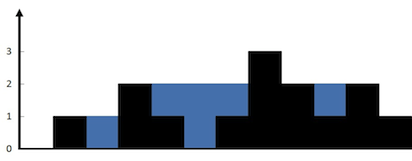
High 困难;给定 n 个非负整数表示每个宽度为 1 的柱子的高度图,计算按此排列的柱子,下雨之后能接多少雨水。
输入:
height = [0,1,0,2,1,0,1,3,2,1,2,1]输出:
6;解释:上面是由数组[0,1,0,2,1,0,1,3,2,1,2,1]表示的高度图,在这种情况下,可以接6个单位的雨水(蓝色部分表示雨水)。
class Solution:
    def trap(self, height: List[int]) -> int:
        stack = []
        res = 0
        for i, h in enumerate(height):
            while stack and h >= height[stack[-1]]:
                j = stack.pop()
                if stack:
                    left = stack[-1]
                    curWidth = i - left - 1
                    curHeight = min(height[left], h) - height[j]
                    res += curWidth * curHeight
            stack.append(i)
        return res